Saturday, March 26, 2016

Who Are You?!?!

*Disclaimer, this blog is meant to be both educational and entertaining.  The information shared here should not be a substitute for your own research.  Additionally as new information comes to light through books and other reputable sources, facts shared here are subject to revision.  Constructive feedback is welcome as long as it is appropriate and professional*

The more I reflect on my experiences as a re-enactor and write this blog the more and more I realize how eerily similar I am to Alice from Alice in Wonderland.  So for this next post I'm going to travel back to Wonderland once again.  Let's be honest, there's not a lot of women in this hobby who choose to do an Axis impression more particularly a German female impression and you may at times get questioned about why you are doing your particular impression.  Whether you're a newbie or veteran you may just feel like your encounter several versions of Wonderland's Caterpillar both in fellow re-enactors and with the public. You will get asked "who are you" and you will need to be able to answer this question from a historic representation and a personal representation at events.  This was my biggest fear going into my first event but once I understood who I was personally as a re-enactor and knew how to answer that question to guests the fear turned into excitement and enjoyment at events.  


My very first Caterpillar

As I mentioned in "Take the leap and the net will appear," D-Day Ohio was my first event as a re-enactor and I was incredibly nervous going into it.  I literally felt like a new kid going into my first day at a new school and how everyone was going to perceive me.  I knew I had my White Rabbit by my side and my Cheshire Cat was going to be there too, but who were the other people I would encounter.  Well to be honest, one of those first people happened to be exactly like the Caterpillar Alice encounters in the garden.  He was talking with my White Rabbit and then paused and turned to me and asked, "Who are you exactly?"  This caught me off guard and just as Alice stumbled over explaining herself I did the same.  For as much as I knew my personal goals as a re-enactor and had done my research on who I was representing in my impression I hardly knew who I was in relation to everyone else that lived in Wonderland.  

That brings me to the first point of this post, know who you want to be among other re-enactors in your unit and the hobby as a whole.  Are you content being the significant other of another member of your unit?  Do you  consider yourself a serious re-enactor and desire to have others look at you that way too?  Do you want to carve your own path and let your reputation speak for you?  How will you answer that question when a fellow re-enactor asks you, "Who are you?"  However you choose to answer that question answer it with confidence and never be ashamed or embarrassed of your response.  

After a split second of panic and feeling my cheeks go red in embarrassment, I answered that question as confidently as I could to the Caterpillar.  I wasn't someone's significant other, I wasn't there as just some random girl who's tagging along for a fun weekend with a friend.  I was a Luftnachrichten Helferin, I was a German re-enactor, and I was there to represent women who served Germany during the war as accurately as possible and deserved to be respected as a re-enactor like others in the hobby.  At that precise moment I knew exactly who I was.  I may have surprised the Caterpillar with my response and to this day I don't remember the exact words I said to him but I like to think it was enough for him to pause and take another look at who I was going to be as a re-enactor compared to possibly other women he had met in the past.  

Now before you form a negative opinion about the Caterpillar, I want to say he has become one of my close friends within the hobby.  He has my utmost respect as a re-enactor, he's one of the most knowledgeable men I have ever met in this hobby and is extremely dedicated to representing this history as accurately as possible.  He strives to elevate everyone around him in the hobby as best he can.  He's challenged me, supported me, and overall has helped me become the best helferin re-enactor I could possibly be.  He always encourages me to continue to grow in my impression.  In my personal opinion it's all because he was the first person to challenge me and ask the question "Who are you," to force me to decide truly who I was as a re-enactor.  If it wasn't for that, who knows where I would have ended up in this hobby.  
The (in)famous Caterpillar, and I, at Rockford 2015
Who are you?

As long as there are public guests attending events you should be prepared to answer the question from them, "Who are you?"  If you're an representing an Allied civilian, you will be asked this question.  If you are representing  a CWAC, you will be asked this question.  If you are representing a French partisan, you will be asked this question.  And if you are representing a German Helferin, you will be asked this question.  

When I'm at an event I love talking to the public!  My goal at every single event is to successfully engage the guests and teach them about history in an interesting and entertaining way.  If I have even a single guest walk away from the display or camp I am participating with having learned something new I consider the event successful.  

How do I answer the question "Who are you" though when talking to the public?  First off it's important to have confidence through body language and speech to the guest.  I'm not ashamed of the impression I represent and by demonstrating to guests with my body language and intonation that I am passionate and proud about this impression draws them in and often creates a more receptive mindset to the brief history lesson I'm about to give them.  
How do I answer someone who approaches me and asks who am I?
I say to them exactly who I am and then connect it with something they might already be familiar with.  In my case my opening response will almost always be, "I represent a German Luftwaffe Helferin which was Germany's female auxiliary service for their Air Force branch of the military."  This gives them the historic term but then connects it with something they already may know about.  For 90% of the guests you engage with this will draw their interest and even open the door for you to talk further with them about the history of women in the role your are representing.  

I'm not to sugar coat it but re-enacting German is not for the faint of heart and isn't for everyone.  Our uniform insignia, although historically correct, isn't something everyone feels comfortable wearing.  To be clear no one as a German re-enactor nor does any event ever represent the partisan side of that history during the war.  I choose to do my particular German impression because these women who served Germany in their respective roles deserve to be represented in the telling of history just as much as those women who served as Allied Auxiliaries.  

Now I'm also not going to lie to you about a particular question, if you are doing a German impression you will eventually encounter one of the toughest questions to tactfully answer.  Inevitably someone will ask you, "Are you a..." in reference to the political party in power in Germay during the war, and here is your opportunity to positively connect with them and educate them about history.  The first time you get asked this question it may be tough to answer, but if you've researched your impression thoroughly you will know the historically correct and accurate answer to give.  Explain calmly and clearly that you are not what their perception might be and answer factually who your impression truly represents.  Some guests will receive that well and appreciate the clarification even invite you to share more information with them.  Unfortunately for a small fraction of guests, no matter what historic facts you attempt to explain to them it will not change their minds.  Stay calm, confident, and genial when interacting in these situations and that's the best you can do.  

How will you answer?

You may be like Alice right after she arrives in Wonderland or you may have been in Wonderland for an extended period of time.  Regardless of your experience level, how will you answer the question "Who are you?"  Have you answered this question for years and you know exactly who you are to your fellow re-enactors and are extremely comfortable explaining your impression to the public?  Maybe this is a work in progress for you?  Maybe you are self-reflecting yourself to truly know how to respond?  Either way once you know this answer be confident in your response no matter who is asking it.  

One of the things I love about this hobby is the diversity.  There are so many people who re-enact they come from all different walks of life and bring something unique and interesting to this hobby.  There is never any right or wrong answer when defining yourself within the hobby, and every re-enactor can have a different approach and style in communicating who their impression is to the public as long as it has a positive impact on the guest's event experience.  

Figuring out my response to both situations when this question was brought up molded me into who I am as a re-enactor.  If I never encountered my Caterpillar early on I honestly don't know how I would have grown into because the positive impact his question had was instrumental to take me to where I am today.  

So consider me acting as your own Caterpillar and I'm going to ask you this question.
  
Who are you??


Sunday, March 13, 2016

What (not) to Wear

*Disclaimer, this blog is meant to be both educational and entertaining.  The information shared here should not be a substitute for your own research.  Additionally as new information comes to light through books and other reputable sources, facts shared here are subject to revision.  Constructive feedback is welcome as long as it is appropriate and professional*

Several years ago there was a show on TLC that was called "What Not To Wear."  It was the classic makeover show but one thing I always loved about it was the stylists taught many of the guests how important it was to invest in quality pieces for their wardrobe and how investing in their wardrobe will ultimately impact them positively in other aspects of their life.  This concept I think carries over well to re-enacting and why I'm calling this post "What (not) to Wear."  I'm not going to sit here and write what you should or should not purchase for your uniform and where but instead hopefully I can help you understand how a well educated investment in your uniform will positively impact your experience in this hobby.  


It's been 16 months since I started re-enacting and 12 months since I purchased my first uniform.  Since then I've had countless people approach me with questions on where to buy uniforms, what are good quality ones, how accurate are various reproductions etc.  So I decided it's time I put some of this down into a post to share with everyone.  Before we get too far into this post I want to let you know this is focused on German Helferin uniforms since my level of expertise lies in this arena instead of Allied Female Military Uniforms.

The "walking out" uniform is the most common uniform worn by women at reenactment events.  This is the standard wool uniform that women were issued during the war and what they wore when they were "walking out" or out in public when they were stationed in occupied territories.  Helferin were actually not allowed to wear civilian clothing outside the borders of Germany when in service.  The walking out uniform consists of a jacket/tunic, skirt, blouse, necktie, and overseas cap but the colors and details varied by service branch.  

Research, Research, Research

This has been and will remain a common theme of my informational posts.  Do your research before you purchase anything.  Make sure you are knowledgeable on the basics of your impression's uniform requirements.  This information is relatively easy to find, most of the recommended reference books I listed in a previous post should have this information.  Although not to substitute for your own research I've listed a basic description of some of the most common impressions below.

Nachrichten Luftwaffehelferinnen:
This uniform consisted of a blue-grey wool comparable to the color wool worn by the men in the Luftwaffe branch.  The tunic was a 3 button single breasted jacket with no front breast pocket and worn with a skirt with two kick-pleats in the front.  A light blue blouse was worn under the tunic but a white blouse was allowed on special occasions or Sundays; both blouses had a black tie and Luftwaffe service pin that were worn with it.  The overseas cap was the same style as the men's cap but no cockade was worn on the hat with the insignia and had a gold-brown piping along the top flaps of the cap .  

Examples of a Reproduction LW Helferin Uniform,
Photos Courtesy of Matthew Sperzel Photography
Nachrichtenhelferinnen des Heeres:
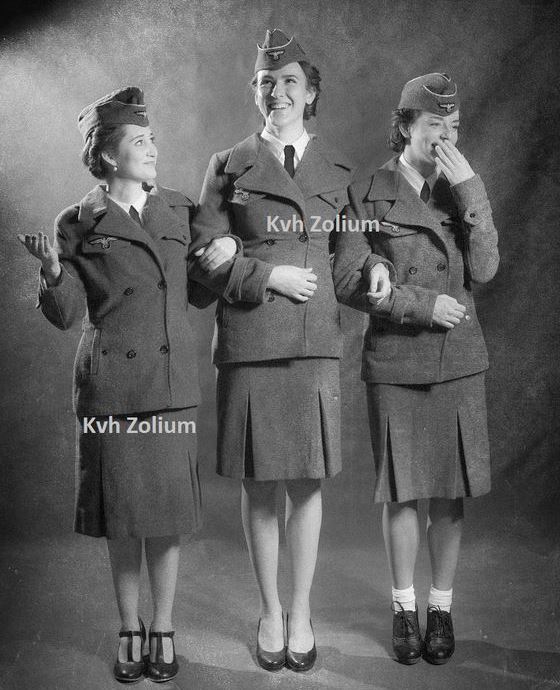
This uniform consisted of a grey wool but typically was not the feldgrau color most men's uniforms issued for the Heer branch were made of.  The tunic was double-breasted with two rows of two buttons each, it also had two front breast pockets with flaps, and at the waist were two additional pockets without a flap but with a button closure.  At the cuffs on the tunic there was buttoned tabs and on the back of the tunic a two buttoned half belt.  This tunic was worn with a skirt with two front kick-pleats and one back kick-pleat.  A gray or brownish-grey blouse with a black tie and blitz service brooch were worn under the tunic.  The overseas cap was similar to the M1938 cap worn by Heer officers, the semi-circular front had lemon-yellow piping along with the insignia and blitz patch.  
Photo Courtesy of Kvh Dolium on Pinterest
SS Helferinnen:
This uniform consisted of either a mouse-grey or Feldgrau wool.  The tunic was a 3 button single-breasted jacket with a front breast pocket worn with a skirt with two kick-pleats on the front.  A white blouse was worn under the tunic but without the black necktie worn by the Luftwaffe and Heer branches.  The overseas cap was either black.  (The SS Helferin is the branch I know the least about, if this is your chosen impression do plenty of research on the uniform for more details.)
Example of a Reproduction SS Helferin Uniform
You get what you pay for

It's no lie that with anything you purchase in today's world you get what you pay for.  If you spend $100 on a 42" TV don't expect it to be well made and come with as many fancy details as a $500 42" TV.  The same will go for your uniforms for this hobby.  If you purchase the $150 budget uniform from Ebay don't expect the quality and level of detail to be the same as the $700 uniform made in Germany. 

The quality of wool is key on uniforms, ideally you want a tightly woven wool.  The looser the weave the quicker the fabric will wear thin and eventually become threadbare in certain high friction spots on the garment and the looser the weave the lower cost per yard/meter the fabric costs.  Most of the wool used by Asian manufacturers are a looser weave which allows them to keep the cost of the garments low in price.  

The accuracy of the color can be related to the price of the uniform.  It is true that there was quite a bit of color variation that existed in the uniforms during the war due to the dye process used on the raw wool fibers but there also is certain spectrum that the uniform should strive to stay in.  Understand a low cost reproduction Luftwaffe uniform may be a bright blue instead of a blue-grey wool but as I said, you get what you pay for and make sure you do your research before purchasing.  

Details are what set high quality uniforms apart from the low cost reproductions too.  Investing in a $700 European made uniform will likely yield you a well tailored uniform with all the details to make it as accurate as possible such as the proper placement of pockets, correct color piping, and well made insignia.  A $150 reproduction may be mass produced and not well tailored, the piping may not match the correct color, and the insignia may not be the best quality.  

What's on the market?

Before I get into evaluating what's out on the market, I want to preface this by stating I am not endorsing nor discouraging purchases from any of these vendors.  If you feel a particular vendor is the one you want after doing your research then go ahead and purchase it.  This post is designed to simply help you understand more what you are looking at.  

Ebay Sellers

Recently a new Ebay listings for reproduction uniforms have entered the marketplace with reproduction sets and headwear.  They are listings include LW Helferin, NHdH, and SS Helferin uniform sets and most of them are listed for approximately $155 USD for the tunic, skirt, blouse, necktie, and cap which can appear as a steal when it comes to reproduction WW2 German uniforms.  The low price can be very attractive to re-enactors who are new to this impression and getting the whole uniform set for less than what some men's uniforms start at will make them want to jump at it.  

Remember though you get what you pay for and it looks like these uniform sets may have several inaccuracies to them.  

Let's look at the LW helferin uniform to start with.  This uniform has a front breast pocket which is incorrect for their uniform standards.  The piping on the hat also appears to be a lemon yellow instead of the gold-brown piping which was correct for LW Helferin.  The blouse should be a full button down instead of a half button down front.  The color appears to be in the correct blue-grey spectrum for the service branch and the tunic is the correct single-breasted front cut.  

The NHdH uniform has the correct double-breasted tunic and also a decent grey color.  The hat also has the right lemon yellow piping.  The skirt unfortunately does not appear to have a back kick-pleat, the blouse is also a half button-down instead of a full button-down, and the cap also seems to have an abnormal cut to the semi-circular front.  It comes standard with a white blouse which means if this uniform set is purchased the gray or brown-grey blouse would still need to be purchased. 

The SS Helferin uniform appears to be the best out of the three, unfortunately I can't willfully speak on details because I do not have the depth of knowledge to provide insight on that.  

Reproductions from India

I've heard numerous mixed reviews from a vendors from India.  Despite this I would consider these uniforms to be mid-range when it comes to price.  They typically will run close to $300 for a tunic, skirt, and hat.  The website for one of these vendors does have grainy pictures which can make it difficult to determine the quality of the garment and details associated with it.  On the website they list the uniform as a generic "helferin uniform" but it actually is the LW Helferin uniform.  The benefit is that they do make the uniform somewhat custom tailored to your measurements and can accommodate larger sizes.  

The wool they use is a looser weave wool and also tends to be a brighter blue than a true blue-grey.  The color shouldn't be ruled out as completely inaccurate due to the dye lot variations during the war.  This vendor does send complimentary fabric swatches by request so if you want to purchase from them I suggest requesting the swatch prior to purchase.  

All in all though if you choose to purchase from this vendor, see if you can talk with other re-enactors who have purchased from them and get their first hand opinion or advice.  If you connect with someone who has purchased from them in the past you'll probably get a chance to see the uniform in person to see the quality of the wool and craftsmanship.  

Feldissue

This vendor I personally and highly recommend.  I purchased my uniform from them and the quality and level of detail is impeccable.  This vendor's uniforms are definitely on the high end when it comes to price.  One of their uniforms typically is quoted at approximately $700 for a tunic, skirt, and cap.  The uniform is made based off of original wartime patterns and sewn in Germany.  Due to the fact they use original patterns they don't 100% custom tailor it to you but will take your measurements and alter the pattern ranges to fit for your size as best as possible.  

Feldissue currently produces uniforms for LW Helferin, SS Helferin, and also have a Flak-helferin uniform in process.  All three uniforms use very high quality wool with a tight weave and fairly accurate dye colors.  They provide fabric swatches upon request which I also highly recommend prior to investing in one of their uniforms.  

Uniforms from Feldissue Top R-Left:
SS Helferin, Flakhelferin, LW Helferin
Photos Courtesy of Feldissue.com

These uniforms are manufactured in Germany but shipped from England.  Due to this the pricing is in GBP so you will have to deal with exchange rates when purchasing from them.  The insignia can also be purchased from them but is shipped separately from the uniform.  

All in all if you can afford these uniforms I highly recommend you invest in them.  Earlier in this post I talked about the differences between a $100 TV and a $500 TV.  Consider Feldissue to be your "$500 TV" investment, they are much better made than the "$100 TV" because the craftsmanship and quality.  If you invest in this uniform it will last several years for you and hold up to all sorts of conditions, a $700 investment that will last you 6-10 years and only end up costing less than $150 per year.    

Make the choice which will work the best for you

I think I've rattled on long enough in this post so I'm going to wrap this up.  Of course there's countless more details I can go into about uniform specifics and if you are interested in further discussion feel free to contact me.  

One last time for this post, do your research ahead of time.  An investment in a uniform is probably going to be the largest investment you will make when building your impression.  Glossing over the research and purchasing an inaccurate uniform or poor quality uniform can make or break your impression and your enjoyment of the hobby.  

When shopping around for your impression's uniform make sure you do your research and make an educated decision for your investment, talk with the vendors ahead of your purchase, and talk with other re-enactors in the hobby and their opinions of different vendors.  Match the price point and quality with your goals for your impression and what you ultimately feel is going to be best for you.  If the economy reproduction is the best fit for you then go for it, if you decide to invest in the higher end uniform own it when you wear it, but whatever you choose to purchase the most important thing to remember is accuracy.  We represent history and actual people in our impressions and we don't want to disrespect history by being inaccurate no matter what the price point is.  

Sunday, February 14, 2016

Take the leap and the net will appear

*Disclaimer, this blog is meant to be both educational and entertaining.  The information shared here should not be a substitute for your own research.  Additionally as new information comes to light through books and other reputable sources, facts shared here are subject to revision.  Constructive feedback is welcome as long as it is appropriate and professional*

Someone who has had an incredibly positive influence on me in another time period has always taught performers to "Leap and the net will appear."  What exactly does that mean?  It means that sometimes you need to put yourself out there and make yourself vulnerable because there is always a net there to catch and support you even if you stumble.  So with that in mind I figured I should take a break from the more informative posts and tell you a bit about my very first experience at an event as a WW2 re-enactor.  This summary is probably going to be a two-part blog post so stayed turned for the second half after reading this one.  I took a huge leap by committing to debuting at this event and my net certainly did appear!

Every August in the small town of Conneaut, Ohio over 1,000 WW2 re-enactors descend upon a local park on the shores of Lake Erie for a 2 day event.  The event that is put on is the largest D-Day reenactment in the United States with an estimated 20,000 spectators arriving on Saturday alone to view the headlining beach battle, visit the encampments, and see various other town battles.  The beach battle is quite impressive, complete with amphibious landings by Allied re-enactors from Higgins boats.  
Event Poster for D-Day Conneaut 2015
Higgins Boat at D-Day Conneaut
What have I gotten myself into?

To put my timeline in perspective from when I decided to start developing an impression to this first event; I decided to pursue my impression in November and my first event wasn't until the following August.  This was a span of nearly 9 months!  I'm not going to say it's a requirement that you take that amount of time to develop your first impression but I really wanted to ensure I felt confident on the impression I was representing.  I hope that you dedicate yourself as well though to accurately represent your impression as well, whether it is 2 months or 9 months to prepare.  

On an early Thursday morning in August my "White Rabbit" and I loaded up our vehicle full of gear and hit the road en route to Conneaut by way of Wisconsin, Illinois, and Indiana.  Seven plus hours later, several pit stops, and some pretty awesome car karaoke sessions we were pulling into Conneaut, Ohio.  (Note:  There may or may not be video of me rocking out to some Spice Girls during the road trip.)
The White Rabbit & I on our way to Conneaut, Ohio
That's when it started to hit me, the reality that this event, my very first event was happening and there was no going back.  "What am I doing?"  "Did I make a huge mistake?"  "Will the guys in camp like me?"  I was second guessing everything, my stomach was in knots, and my heart was racing.  No matter how many words of reassurance my white rabbit said to me nothing was helping.  When you go to your first event I guarantee you almost certainly will have some sort of nerves as well.  The best advice I can give you to remember and work through the emotions, take a leap and the net will appear!  You may worry about how you will do but trust me in the re-enacting community there are some many of your fellow re-enactors ready to be that net and support you because they want to see you succeed too.  

You want me to sleep where?

Okay, before I get too far I want to give credit and recognition to the unit who allowed me to participate with them at D-Day Ohio.  There aren't really any Helferin units out there so as a female re-enactor particularly on the German side you will need to find a regular men's unit which will allow you to "fall in" with or join for events.  Remember in earlier posts I talked about networking? This is exactly why it is important to do so, without networking you may end up unit-less and unable to attend certain events you want to attend.  Remember though that different units have different membership requirements and kit requirements so make sure you talk with the unit commanders to understand their requirements before making assumptions about joining.  

I was invited to participate with the FJ's at this event.  For D-day Ohio all the regional regiments from around the country combine to form one large unit referred to as FJ-Kampfgruppe.  The unit leaders that organize such a large group deserve a lot of credit for all the hard work they put in to organize such an excellent display.  They plan out the layout of the camp on the beach, the schedule throughout the weekend, and lead several activities such as drill, marching in formation, and training exercises.  All in all they put on a great display to accurately represent an encampment of FJ's in stationed in Northern France.  
The FJ's getting ready for one of the event battles, D-Day Conneaut 2014
Leading up to this event the question of sleeping arrangements came up.  Most men in the hobby own, at a minimum, a set of Zeltbahns which are triangular camouflaged pieces of water-proofed fabric that were used in the war for rain protection and then linked together to create tents for the soldiers to sleep in while in the field.  Other re-enactors have invested over time in larger stand-up canvas tents to make sleeping out at events slightly more comfortable.  As this was my very first event I had not yet invested in any zelts myself and so had been assigned to sleep in a larger troop tent with some other guys who might not have zelts either.  

So as we pull up to the encampment, my nerves are at an all time high and have no idea how I was going to calm them down.  I get out of the car and walking towards me is that Cheshire Cat from Rockford, grinning as big as could be walking towards me.  The gentleman I refer to as my Cheshire Cat and I had stayed in touch over the months since Rockford and the development of my impression and we had actually become quite close as friends.  Despite this, Ohio was the first time we had seen each other in person since the last September so we had quite a lot to catch up on.  Some long overdue hugs were exchanged, and then he turned to me and said, "So we may have a problem."  As it turns out the gentleman who was supposed to bring the tent I was assigned to sleep in wasn't actually coming anymore.  

"It's okay though, we have a plan B for you. One of the guys is going to set up his extra zelt for you to sleep in so you'll have some privacy too." said the Cheshire Cat.  
Photograph of a German soldier next to his Zelt setup in a tent arrangement.  Imagine my thoughts trying to process sleeping in one of these!
To be honest, I'm not a camper, I don't normally do well roughing it and now I'm going to have to sleep in a tiny tent all by myself on the ground all weekend long.  How on earth am I going to do this, and so many other thoughts were going through my mind, all of them were not helping my nerves.  After taking a few seconds to process it, I realized I didn't have any other choice so here goes nothing.  Sarah, a non-camper, not really outdoorsy is going to sleep on the ground for the next 3 nights all on her own, get dressed in such a confined space, do hair and makeup in a small tent, and generally make herself presentable each day of the event.  Yikes!  

I do have to say undertaking the task of sleeping in a zelt was the ultimate test of the "Leap and the net will appear" philosophy!  Luckily I can say I survived otherwise I wouldn't be writing this post.  What were the results of sleeping in this Plan B zelt option?  Stay tuned for the next post!

To be continued...

Stay tuned for the next post where you will find out if I survived my first night in a Zelt and learn how exactly I met my own versions of The Caterpillar, The Madhatter, and The March Hare on my journey through re-enacting Wonderland.  

Links worth checking out:
D-Day Ohio Event Website:
http://www.ddayohio.us/

Fallschirmjäger-Lehrkompanie (FJR6) Website:
http://www.fjr6.com/FJ-LEHR/fjlehrkompaniecom/index.htm

Friday, February 5, 2016

Money doesn't grow on trees and neither do Impressions

*Disclaimer, this blog is meant to be both educational and entertaining.  The information shared here should not be a substitute for your own research.  Additionally as new information comes to light through books and other reputable sources, facts shared here are subject to revision.  Constructive feedback is welcome as long as it is appropriate and professional*

A recent email I received along with some discussions at a recent event got me to thinking it would be a good time for this next blog topic.  Let's talk about money, budgets, and affording your impression.  I want this blog to be informative and helpful to anyone that reads it but in order to do that I also am going to be honest with anyone that reads this.  To be perfectly honest, this hobby isn't cheap, it's actually pretty expensive for the basics, but don't let that prevent you from pursuing it if that's what you're passionate about.  I firmly believe anyone can afford to do this hobby well as long as you are realistic and do a little bit of planning.    

Examples of 2 different uniform investment options for Nachrichten Helferin
Taken at The Battle of the Bulge re-enactmet event 2016
Let's get down to business

Getting back on track, you've now settled on an impression, you might have delved into a bit of research and even connected with a few potential units.  But before your get too far into this hobby let's get down to the nitty gritty.  No one likes to talk about money or finances but it is key to set realistic expectations of what you can afford right away and what you might need to save up for.  So many times I go to events and see someone in a cheaply made uniform or a uniform that is completely inaccurate that they purchased simply because it's all they could afford at the time and hold back a grimace.  No one wants to be perceived as that person in the hobby, and that can be easily avoided by setting those realistic expectations up front and planning accordingly.  
To put this in perspective, I've only been doing WW2 re-enacting for about a year and in that year I've spent close to $3,000 on my uniform and associated kit items.  You don't have to spend $3,000 in your first year but if you're starting from scratch a minimum realistic budget should be at least $1,000 allocated to make an basic impression.  This will vary depending the specific impression too and what specific requirements your unit commander might have.  A Heer nachrichten impression for example, where reproduction uniforms are available from multiple vendors might be closer to $1,000 for the whole kit while a Luftwaffehelferinen with only 1-2 vendors for uniform could require a much higher budget.  

Now you're probably wondering how I managed to come up with these numbers?  Or how does this all break down?  Remember this will vary from person to person and impression to impression, and it may also vary from unit to unit based off of their requirements but let's take a quick look at how this all adds up.

Uniform Basics

Heer Helferin in Paris
Source:  Glory:  The largest archive of German WWII images on Flickr

The typical uniform you see at events for women portraying German Helferin is what is called the "walking out" uniform.  This is the skirt, jacket/tunic, collared blouse with tie, and overseas cap.  On the low end your uniform could cost as cheap as $250 all the way up to $800 on the high end.  Prices depend on the quality of the wool, skill of the tailor, and whether it is tailored to your measurements or an off the rack size.  In addition to the uniform piece there will also be insignia that will be required.  Your insignia can add up to $75-$100 or more.  Collared blouses will also need to be purchased to wear with your uniform tie.  

The uniform is not the only clothing pieces you will need though.  You're going to need uniform shoes to wear at events.  Acceptable uniform shoes are black lace up oxfords either flat or with a slight heel.  Modern reproduction style shoes will be an additional $50 approximately while vintage or vintage deadstock can cost up to $100.  

Examples of uniform shoe styles
Source:  353.Infanteriedivision Standards for Nachrichten


Foundations are key

You will also need foundation garments to wear.  Not every re-enactor has to go 100% to the level of accuracy for a period bra or underwear so we will omit those estimates but you will definitely need a garter belt and stockings.  A quality and durable garter belt let's estimate will be $40 and stockings $20 a pair.  Plan on investing and needing at least 3 pairs for your first event.  A rule of thumb to pack or have available 2 pairs for every day of an event.  So a 2 day event would mean you need to have 4 pairs with you in case you snag or ruin any during the day or evening activities.  

Accessories are key

In addition to your uniform, basic kit items will be critical for your survival at an event.  When I refer to "kit items" I mean things like your canteen, mess tin, silverware, blankets, and other items.  All these items can be purchased from several online vendors at varying price points, varying quality, and varying accuracy levels.  The best advice I can provide on these items takes me back to the previous post about networking in the hobby.  Ask your fellow re-enactors what they recommended but also ask multiple people just because one person swears by an inexpensive mess tin doesn't mean it's always the best investment.  

Canteen & Mess Tin Reproduction examples
Source:  At the Front

Check Please...

So totaling it all out a good expectation of what your budget will look like this:

Uniform (Median price) - $350
Insignia - $100
Uniform blouse & Ties - $75
Foundation Garments - $$75
Shoes - $50
Kit Items - $250
Total - $900

As you can see budgeting $1,000 as a starting point is not unrealistic.  Remember that these numbers are subject to variance depending on the vendors you choose to go with.  

Avoiding common mistakes
Research, Research, Research!
World War II German Women's Auxiliary Services published by Osprey
Now that we've shown some numbers I want to go into another honest topic concerning so many common mistakes I see at events.  First and foremost, not doing your basic research.  Remember you are representing actually women who served and put their lives on the line, they deserve accurate representation and not just an easy inexpensive out.  With that said research, research, research, before you buy!  Know what the uniform requirements were and what details were important on the women's uniforms.  If you choose to do a flak-helferin impression, slipping on a pair of men's uniform trousers, a fliegerbluse, and adding a flak badge does not mean you have a historically correct uniform.  

Note Women's Flak Helferin pants were different from Mens pants!
Think twice about picking up a modern skirt at goodwill just because it'll be good enough for now when maybe you're better off waiting a paycheck or two and purchasing that vintage skirt off of etsy which is much more correct.  Again always do your research before purchasing.  

All in all hopefully I've helped put some of this in perspective, this hobby is what you make of it.  We realistically desire to represent the men and women of this past generation accurately and respect them for the service they provided their countries.  In order to do this keep in mind cheap is not always the best route to go to achieve this.  

Notable reference sources & links

World War II German Women's Auxiliary Services by Osprey Publishing (Men-At-Arms book)
Blitzmädchen. Die Geschichte der Wehrmachthelferinnen im Zweiten Weltkrieg by Franz W. Seidler (ISBN:  3763759573)

https://www.flickr.com/photos/farinihouseoflove/
http://353id.org/nach.html

Vendor Links (not all inclusive)

Kit Items:
http://atthefront.com/
http://www.hessenantique.com/
http://www.kelsmilitary.com/SFNT.html

Uniforms:
http://feldissue.com/
http://schusters.ru/en/shop/germany-1933-1945/uniforms-4/


Sunday, January 17, 2016

Choosing Your Impression & Starting Your Research

*Disclaimer, this blog is meant to be both educational and entertaining.  The information shared here should not be a substitute for your own research.  Additionally as new information comes to light through books and other reputable sources, facts shared here are subject to revision.  Constructive feedback is welcome as long as it is appropriate and professional*

Now that we got introductions out of the way and you've learned a little more about how I got into the WW2 hobby let's start exploring some topics which might be helpful to those looking to develop their own impression.

Allied or Axis, Military or Civilian?

When choosing to develop a new impression you'll need to answer two questions right away to determine what direction you want to go in.  First and foremost, do you want to represent the Allied side or Axis side?  Portraying an Axis impression is not for everyone but you can't truly represent the conflict and events of WW2 without having both sides represented.
Female Allied Military Impression, photo by Tom Davison
Once you've decided whether you're going to represent the Allied or Axis side the next question to answer is whether you'd like to represent a Military impression or a civilian impression.  Remember as a woman in the hobby you aren't required to do a one or the other although an Allied civilian impression often seems to be the most common.
Female Civilian Impressions at Rockford WW2 Days, photo by Tom Davison
Find the right fit for you

The best piece of advice I can give is to find the impression that is going to be the best fit for you.  You might have friends in the hobby and they may do civilian impressions so initially joining up with them might work well.  You might have a significant other who does an Axis impression and you want to attend more events with them so you're choosing to do an Axis impression.  Or you might be entering this hobby because you want to do an impression that you are passionate about and are doing this for your own enjoyment.  Don't choose an impression because someone told you to do it, if it doesn't fit your personality there are plenty of other options available to you.

I personally thought I could never do an Axis impression when I started researching what direction to go in.  After a lot of contemplation and additional research I did decide to do a German Helferin impression.  In particularly, I chose a Luft-nachrichten Helferinnen impression which is a woman who served in the German auxiliary services of the Luftwaffe branch specifically the Nachrichten role was a communications role.

This impression was not an easy impression to develop or research and required a lot of dedication in order to be successful.  While developing the impression, many suggested I forego it and choose another that might be easier.  As I said above though, you need to choose an impression that fits you and the goals for what you want to get out of this hobby.  I stuck with this my chosen impression and I don't regret it for a moment.
Heer & Luftwaffe Helferin, photo by Matthew Sperzel photography
Now you're settled, what's next?

So now you've settled on your impression where do you go from here.  Before you go to any events it's important to do research.  No matter what role you represent, remember you are representing actual women who lived and served in these roles and they deserve accurate representation.  Going to an event is more than dressing up, sitting around camp or the event site, or drinking and partying.  Thousands of people pay to attend events throughout the country to learn more about this time in our history and several veterans still come out to these events who's history you will be representing too.

The best way to start your research is to start networking within the hobby.  Do you have a unit you'll be joining? Talk to the unit commander, ask them what are good resources they recommend.  Start talking and getting to know others in the prospective unit you'll be joining for recommendations as well.

In today's world of social networking, the power of Facebook can be indispensable.  You can connect with people all over the country or world who may already be doing your chosen impression and can give you invaluable guidance.  If you are willing to listen and learn, there almost always is someone out there who will be able to help you.

Never underestimate an old fashioned book

Sure anyone can do a google search for information or look up a topic on Wikipedia but these aren't always good or accurate sources of information.  Many times in this hobby a good old fashioned book is the best source of information.  If you're new to WW2 go to your local library and check out what they have on their shelves pertaining to the war.  Don't always judge a book by it's cover either.  The title may not appear relevant but sometimes some of the most interesting facts I've found for my impression came from books I wasn't expecting to have anything useful.

For specific areas and beginner research look into the Osprey books sometimes referred to as the Men-At-Arms books.  These are available from online retailers like Amazon in both hard copy version and e-reader versions.  They are good starting points but don't stop there after one book with your research, it's always good to have secondary sources to back up your initial research.

For those that are doing Axis impressions, particularly a German Helferin impression or DRK impression and can read german there are a few good books printed in that language.  They also have several original images of these women in service so even if you can't read german the photographs alone can be great reference material.

Recommended Books

Osprey Books:
World War II German Women's Auxiliary Services
World War II Allied Nursing Services
World War II Allied Women's Services
Women at War 1939-1945
The German Homefront 1939-1945

German Published Books:
Blitzmadchen:  Die Geschichte der Helferinne der deutschen Wehrmacht im Zweiten Weltkrieg by Franz W. Seidler (published by Bernard & Graefe Verlag)
Frauen fur die Front:  Gesprache mit Wehrmachtshelferinne by Rosemarie Killius (published by Militzke)

Remember there are countless other books out there that are good resources, these are just starting points.  Do you have a favorite resource?  I'd love to hear what it is so feel free to share it in the comments!